Thinking about buying land in Climax Springs because you want more elbow room, fewer neighbors, and a quieter Lake of the Ozarks experience? You are not alone, but rural land can be very different from buying a typical home site. If you want to build with confidence, it helps to understand how county rules, access, utilities, and floodplain review can shape what is actually possible on a parcel. Let’s dive in.
Why Climax Springs Appeals to Quiet-Seekers
Climax Springs sits in unincorporated Camden County, which means county land-use rules usually guide what you can do with a property. For buyers looking for a more tucked-away setting, that matters because the area often offers a wider range of parcel types than a more typical subdivision market.
Current listing samples show land offerings ranging from small parcels of about 0.37 acres to large tracts of 389 acres. LandSearch also reports 90 properties near Climax Springs with an average property size of 34.1 acres and a median list price of $99,000. While listing data changes over time, the broader takeaway is clear: many buyers here are shopping for multi-acre property, not just standard lots.
County Rules Shape Your Options
Because Climax Springs is in unincorporated Camden County, you will want to start with zoning and land-use rules before falling in love with a parcel. The county’s Unified Land-Use Code includes districts such as A-1 Agricultural, A-R, several residential categories, business districts, and industrial zoning.
For many quiet-end buyers, A-1 and A-R are especially relevant. In A-1 Agricultural, single-family dwellings are allowed on unsubdivided lots at one dwelling per five acres. A-R is intended to preserve rural character while allowing low-density residential use.
That does not mean every parcel automatically works for every plan. Your intended use, the parcel’s size, and whether the land has been subdivided can all affect what is allowed.
Minimum Lot Size Matters
If you are creating new tracts or lots, Camden County generally requires a three-acre average area. There is an important exception when a project is served by an MDNR-approved centralized wastewater system, because the minimum lot area can drop to 8,500 square feet.
That difference is one reason buyers should be careful about assumptions. A parcel that looks large enough on paper may still need more review if you plan to split it, build more than one residence, or rely on onsite wastewater.
Small Lot Splits Need Extra Review
New lots under 2 acres need Planning Commission approval for minor plat treatment. If you are buying land with the idea of dividing it later, that step can affect your timeline and your project design.
In other words, the best parcel for your goals is not always the cheapest or the prettiest. It is the one that matches county requirements from the start.
Building Starts With Permits
Once you identify a property that seems promising, the next step is confirming what permits your project will need. Camden County requires a construction permit application with proof of ownership, a sketch plan, and approvals from applicable agencies.
Depending on the site, those agencies may include the fire district, water district, sewer district, MoDOT, and the Missouri Department of Natural Resources. The permit is valid for one year, and the county may allow one six-month extension.
For buyers planning a custom build, timing matters. It is smart to understand permit requirements early so your closing, design, and contractor schedule stay aligned.
Land Disturbance Can Trigger Another Permit
If your project involves more than one acre of land disturbance, Camden County also requires a land-disturbance permit. Residential site development under one acre is exempt.
That rule can come into play faster than many buyers expect, especially on sloped sites, long driveways, or larger home footprints. If the lot needs significant clearing or grading, this should be part of your early planning.
Water, Septic, and Well Planning
Utilities are often the biggest reality check when buying rural land. In Climax Springs, water and wastewater planning can be just as important as the lot itself.
County code also says that when public water or sewer service can be connected within 1,000 feet, and the connection is legally possible and practicable, development that requires water or sewer service should connect rather than rely on a separate solution. That means you should never assume a well or septic system will be your default option.
Septic Review Is Often a Key Gatekeeper
Camden County requires septic permits for new construction, tank replacement, and repairs in several common situations. The county specifically requires permits for residential lots under 3 acres, residential lots adjoining the Lake of the Ozarks regardless of size, residential lots with more than one single-family residence, most small commercial developments, and multi-family development.
The septic application process requires a soil morphology test, a $150 application, design, and permit fee, and a site evaluation by a wastewater inspector. If setbacks cannot be met, a variance review may also be needed. Septic permits are valid for one year, and installation must be completed by a county- or state-registered installer.
For buyers at the quiet end, this is one of the most important checkpoints. A parcel can feel ideal, but if wastewater design does not work, your building plans may need to change.
Private Wells Need Careful Planning Too
In Missouri, private well construction is regulated to protect groundwater, and well and pump contractors must be properly permitted. At the same time, private well water quality is not monitored or regulated by the state, and the Missouri Department of Health and Senior Services recommends testing at least once a year.
That makes well planning a practical and long-term issue, not just a construction item. If a parcel will rely on a private well, you will want to understand contractor requirements and future water testing responsibilities before you move forward.
Access and Roads Can Make or Break a Build
A beautiful parcel still needs usable legal access. In rural areas around Climax Springs, roads, driveways, and culverts can be a bigger part of the budget and approval process than buyers expect.
Every subdivision lot must have access sufficient for emergency vehicles. If access is through a private road, county code may require public-street standards and recorded maintenance disclosures, and the county will not accept a road for maintenance unless it fully meets county standards.
Driveway Approval Is Not Automatic
Driveway entrances are regulated. County roads are handled by the County Commission and County Highway Engineer, while state roads are handled by MoDOT.
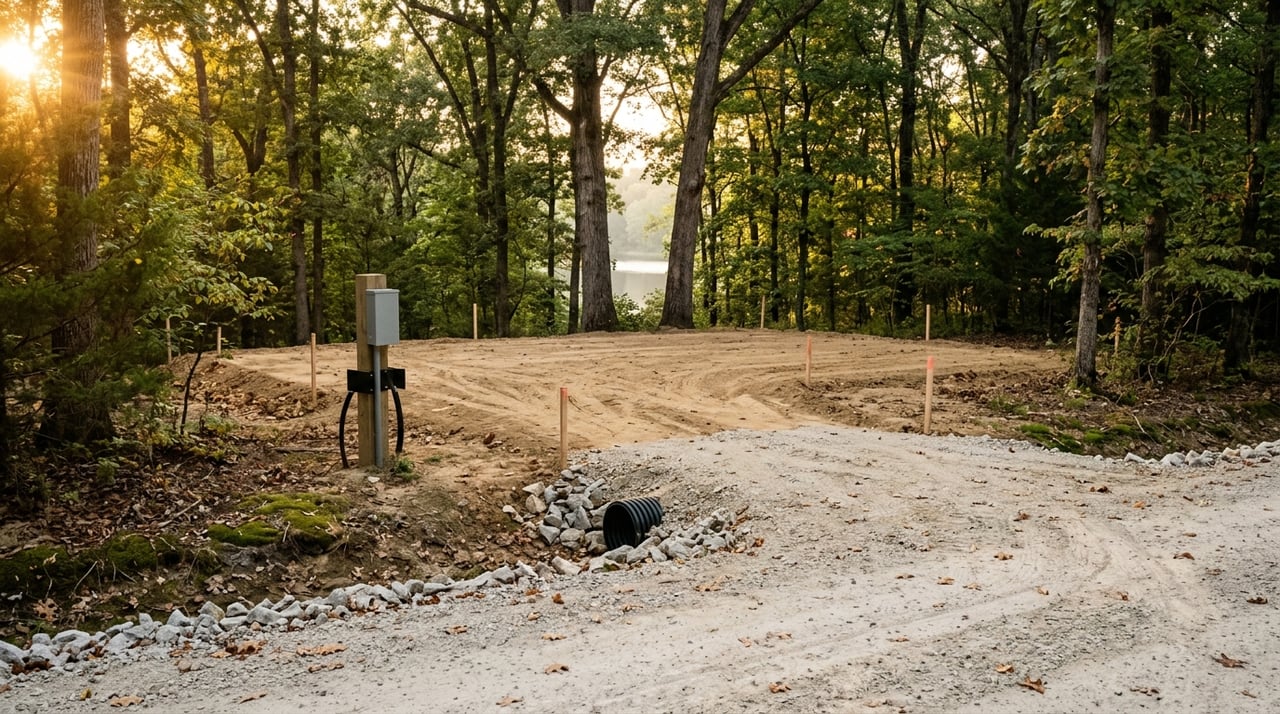
Camden County also notes that developments must comply with Road and Bridge requirements for an Access Permit and, when applicable, a road maintenance impact fee. On new driveways, the property owner supplies and installs the culvert pipe.
Direct driveway access to arterial streets is restricted unless no other option exists. So if you are eyeing a parcel with highway frontage or a steep roadside approach, confirm access approval before you assume the site is buildable.
Floodplain Review Is Essential Near the Lake
At the quiet end, some of the most attractive sites are near the water or in low-lying areas. That can add appeal, but it also raises the importance of floodplain review.
Camden County defines the Lake of the Ozarks floodplain as all land below the 664-foot contour line. Its floodplain permit application requires checking whether a site is in a floodway, fringe area, or special flood hazard area before grading or building.
This is not a box to check at the last minute. Floodplain status can affect where you build, how you build, and whether a property works for your plans at all.
A Smart Due Diligence Order
When you are buying land in Climax Springs, the order of your research matters. A methodical review can save you time, money, and frustration.
Here is a practical sequence based on county guidance:
- Verify the parcel on the county GIS or assessor system.
- Confirm the zoning district and whether the lot size supports your intended use.
- Ask wastewater and well officials whether the parcel can actually be served without a variance or redesign.
- Confirm road entrance and culvert approval before treating the site as buildable.
- Check floodplain status before finalizing price or closing, especially near the lake or low ground.
The county assessor page says parcel ownership data can be searched by parcel number, owner name, or situs address and is updated every Friday. That makes it a helpful first step when you begin narrowing down options.
Questions to Ask Before You Buy
Before you write an offer, try to answer a few key questions clearly. The more certainty you have upfront, the better your decision will be.
- How much acreage do you really need for your intended use?
- If the tract is smaller, does it still meet septic and zoning requirements?
- Will your plans require a variance or redesign?
- Is the road private, and if so, who maintains it?
- Will you need a culvert, access permit, or road work before building?
- Is any part of the site in the floodplain?
- If public water or sewer is nearby, are you expected to connect?
These questions are especially important if you are buying from out of the area or comparing several rural sites at once. What looks simple online can become more complex once county review begins.
Why Local Guidance Matters
Buying land at the quiet end of Climax Springs can be a great fit if you want privacy, flexibility, and room to create something that fits your lifestyle. It can also require more due diligence than buying an existing home, especially when zoning, wastewater, roads, and floodplain factors all come into play.
That is where local market knowledge helps. When you work with professionals who understand Lake of the Ozarks land patterns, county processes, and the practical differences between parcels, you are better positioned to avoid surprises and move forward with confidence.
If you are exploring land or build opportunities in Climax Springs or anywhere around the lake, Albers Real Estate Advisors can help you evaluate properties with local insight and steady guidance.
FAQs
What makes buying land in Climax Springs different from buying a house lot?
- In Climax Springs, county land-use rules, septic feasibility, road access, and floodplain status often play a much bigger role than they do with a typical house lot in a subdivision.
What lot size is usually needed to build in Climax Springs?
- For new tracts and lots, Camden County generally requires a three-acre average area unless the project is served by an MDNR-approved centralized wastewater system, which can allow a smaller minimum lot area.
What septic rules apply to land in Climax Springs?
- Camden County requires septic permits for several common situations, including new construction on residential lots under 3 acres and residential lots adjoining the Lake of the Ozarks regardless of size.
What road access should you confirm for Climax Springs land?
- You should confirm that the parcel has access sufficient for emergency vehicles, whether the road is private or public, and whether driveway entrance or culvert approval is needed before building.
What floodplain issue should buyers check in Climax Springs?
- Buyers should check whether the site is in a floodway, fringe area, or special flood hazard area, especially near the lake, because Camden County requires floodplain review before grading or building.
What is the first due diligence step for land in Climax Springs?
- A strong first step is verifying the parcel in the county GIS or assessor system so you can confirm ownership details and begin reviewing zoning, access, and site constraints.